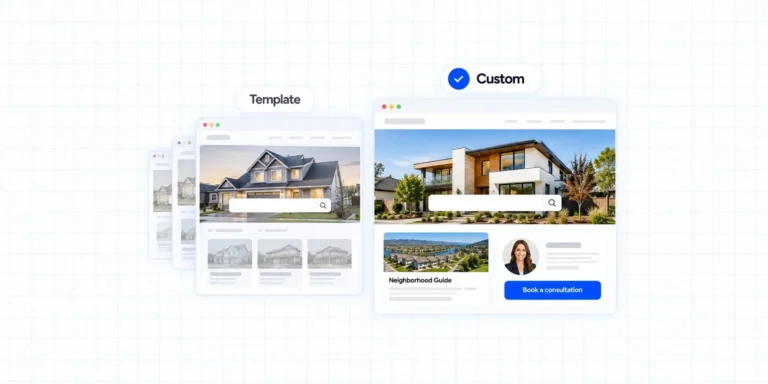
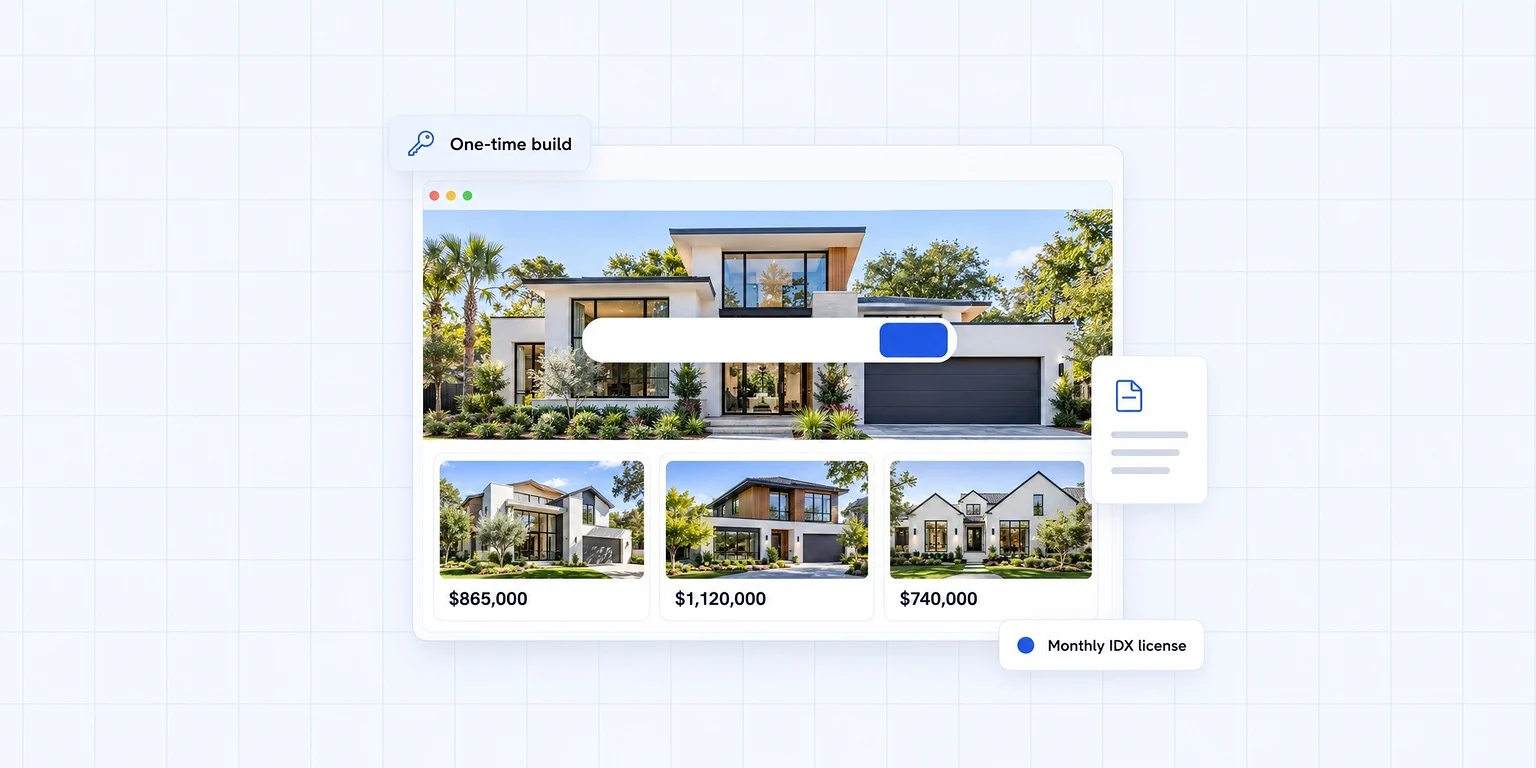
Quick answer: A real estate website cost has three parts, and most quotes only show you one. There is the build (one-time if you own the site, folded into a setup fee if you rent one), the monthly running costs (hosting, domain, and above all the IDX feed for MLS listings), and the cost of leaving. For a solo agent in 2026 that works out to roughly $1,500 to $2,700 in year one for a site you own, and $2,800 to $9,000+ in year one on a rented platform. Year three is where the two numbers stop looking alike.
I build real estate websites for a living, 200+ of them over six years, and the most common question on a first call is some version of “what should this cost?” The honest answer is that the price on the quote is rarely the real estate website cost you end up paying. This guide breaks the number into its parts, shows three real budgets built from published prices, and tells you which line items quietly double the total.
What This Guide Covers
- The three parts of any real estate website cost
- What the build costs, by type of site
- The monthly costs nobody quotes up front
- Three real budgets for 2026
- Real estate website cost over three years
- Hidden fees that change the number
- When a cheap site costs more
- How to get a quote you can compare
- Frequently asked questions
The Three Parts of Any Real Estate Website Cost
Every real estate website, whether it is a $10-a-month template or a $25,000 brokerage build, is paid for in the same three places. Write the real estate website cost down in those three places and the comparison gets easy.
- The build. Design, pages, the home search, lead forms, mobile layout and launch. If you own the site, this is paid once. On a subscription platform it shows up as a setup or design fee plus a share of every monthly payment.
- The running costs. Hosting, the domain name, the IDX provider that pulls MLS listings onto your pages, and any MLS pass-through charge from your board. These recur whatever you choose, so they belong in every real estate website cost estimate.
- The exit. What it costs to leave: whether the domain is yours, whether your pages and blog posts come with you, and how much traffic you lose when the URLs change. Nobody puts this on a quote, and it is often the most expensive line.
Most of the confusion about real estate website cost comes from comparing the first line of one quote with the second line of another. A platform says “$165 a month”. A designer says “$3,000”. Those are not two prices for the same real estate website cost.
What the Build Costs, by Type of Site
Here is how the build portion of a real estate website cost usually breaks down in 2026. These are market ranges, not my prices, and they vary with who builds it and where.
DIY template builders
Wix, Squarespace and general WordPress themes. The build is your own time, which is the real cost. You can get a clean brochure site live for very little money. What you usually cannot get is a proper MLS search that Google can read, because general builders were not made for IDX. If you only need a profile page and a contact form, this is fine. If you want listings to bring in traffic, it is not.
Real estate platforms with a setup fee
AgentFire, Real Geeks, Placester, Lofty and similar. The build is a template configured for you, with a setup or design fee that ranges from nothing to several thousand dollars. AgentFire, for example, publishes design packages from $800 up to $6,500 as a one-time charge on top of the monthly plan, on its own pricing page at the time of writing. You get speed and support. You do not get ownership, and that shapes the real estate website cost every year after.
A custom site you own
A designer or studio builds the site on WordPress (or similar), connects your own IDX license, and hands you the keys. Market prices run from under $1,000 for a focused launch to $5,000 to $15,000 for a fully custom agent or team site, and more for brokerages and developers. Reaplex plans start from $685 one-time, with a Custom plan quoted on a call. The full breakdown is on the pricing page.
Brokerage and developer builds
Agent rosters, office pages, recruiting, multiple MLS feeds, project pages with floor plans and availability. These are priced by scope, commonly five figures, because the build is closer to software than to a brochure. If that is you, the guides for brokers and teams and for developers cover what changes.
The Monthly Costs Nobody Quotes Up Front
The build is the number people negotiate. The monthly lines are the ones that decide the real estate website cost over time.
The IDX feed
IDX is the licensed feed that shows MLS listings on your site. If you own your site, you license it directly from a provider approved by your board. Published rates at the time of writing: IDX Broker’s published price table lists Core at $60 a month and Engage at $99 for a single agent. Showcase IDX lists Essentials at $94.95 a month for two users. So for a solo agent, budget roughly $60 to $150 a month, the largest recurring line in the real estate website cost. I compared the providers line by line in IDX providers compared, and broke down the IDX side on its own in IDX website cost.
MLS pass-through charges
Some boards charge a data fee for each IDX feed, passed through by the provider. It is usually small, often under $35 a month, and it is a separate line on top of the provider. A second MLS means a second feed, and the charge applies again.
Hosting
On a platform, hosting is bundled into the monthly fee. On a site you own, you pay a host directly. Good managed WordPress hosting for a single agent site typically runs $10 to $40 a month. Cheaper exists and lowers the real estate website cost on paper, and you will feel it in page speed, which feeds straight into how Google ranks you.
The domain
A .com typically costs $10 to $25 a year at a mainstream registrar. It is the smallest line on the list and the most important one. The domain should be registered in your name, on your account, whoever builds the site.
Care and updates
WordPress, plugins and the IDX connection need updates and backups. You can do this yourself, or pay for it. Reaplex care plans start from $99 a month, and they are optional, not a condition of keeping the site switched on. That distinction matters later.

Three Real Budgets for 2026
Abstract ranges are not much use when you are trying to decide. Here are three budgets for a solo agent, built from the published figures above. Your real estate website cost will differ by market and board, but the shape will not.
Budget 1: the minimum that does the job
- Build: a focused owned site, from $685 one-time
- IDX: IDX Broker Core, $60 a month, so $720 a year
- Hosting: about $15 a month, so $180 a year
- Domain: about $15 a year
Year one: about $1,600. Year two: about $915, which is just the running costs. This gets you a site you own, with live MLS search and lead capture, and no platform fee.
Budget 2: the typical owned site
- Build: a custom agent site, quoted on scope
- IDX: a mid tier around $99 to $125 a month, so $1,200 to $1,500 a year
- Hosting: $25 a month, so $300 a year
- Care plan: optional, from $99 a month
Year one depends mostly on the build quote. From year two, the real estate website cost is the IDX license, hosting and whatever level of care you choose, typically $1,500 to $3,000 a year all in.
Budget 3: a rented platform
- AgentFire Pro at $165 a month plus the $800 Ignite design package: $2,780 in year one
- AgentFire Plus at $215 a month plus the $6,500 Firebrand package: $9,080 in year one
That is the real estate website cost of renting. Those figures come straight from AgentFire’s published pricing at the time of writing, and they are why the commonly quoted range for renting is $2,800 to $9,000+ in the first year. Year two drops the setup fee and keeps the monthly: $1,980 to $2,580 a year, every year, for as long as you want the site to exist.
Real Estate Website Cost Over Three Years
One year is the wrong window for this decision. A site is something you keep. Here is the same comparison over three years, which is roughly how long an agent keeps a website before a redesign.
- Owned, Budget 1: about $1,600 in year one, then about $915 a year. Three-year total: about $3,430.
- Rented, AgentFire Pro + Ignite: $2,780, then $1,980 a year. Three-year total: $6,740, plus IDX pass-through charges.
- Rented, AgentFire Plus + Firebrand: $9,080, then $2,580 a year. Three-year total: $14,240.
Same agent, same three years, very different real estate website cost. The rented totals buy you three years of a website. The owned total buys you a website. At the end of year three, one of those agents can stop paying a platform and keep everything. The other has a renewal date.
To be fair to platforms: the monthly fee includes support, hosting and updates, which an owned site has to cover another way. Add a care plan to the owned column and the gap narrows. It rarely closes, and the asset still belongs to you. I set the full comparison out, including the cases where renting is the right call, on Reaplex versus rented platforms.

Hidden Fees That Change the Real Estate Website Cost
None of these appear in a headline real estate website cost, and every one of them is published somewhere if you read far enough. Ask about each before you sign.
- A second MLS. If you work across two boards, you usually pay a second IDX feed and a second pass-through charge.
- Extra users. Team seats are often billed per person per month. Real Geeks, for example, publishes additional users at $25 a month each in its lower bands.
- Setup fees. Common on platforms and IDX add-ons. Real Geeks lists a $500 one-time setup on top of $399 a month at the time of writing.
- Domain transfer fees. If a platform bought the domain for you, getting it back can cost money. Real Geeks publishes a $50 fee to move a domain it purchased to a non-Real Geeks site.
- A site you cannot take with you. AgentFire’s own pricing FAQ is clear that your original content, photos and videos remain yours, but the complete website cannot be exported and hosted elsewhere. That is normal for a platform, and it means a move is a rebuild. Budget for it from day one.
- Lost rankings. When you move platforms and the URLs change without redirects, Google treats your pages as new. Rebuilding that traffic is the most expensive hidden fee of all, and it is avoidable with a proper website migration.

When a Cheap Real Estate Website Costs More
A low real estate website cost is not the problem. A low price that skips the things that make a real estate website earn is. Three patterns I see every month:
The iframe search. Many cheap IDX setups load listings inside a frame from the provider’s domain. It looks fine to a visitor. To Google, those listings are on someone else’s website, so your site gets no search traffic from them. You paid for listings that cannot rank. The thirty-second check: open a property page, view the source, and search for the street address. If it is not in the HTML, Google cannot see it either.
The slow template. A theme loaded with sliders, page builders and twenty plugins can take five or more seconds to load on a phone. Most of your visitors are on phones. A slow site costs you leads quietly, every day, and Google’s own guidance on Core Web Vitals makes page experience part of how pages are assessed.
The form that goes nowhere. A contact form that emails an address nobody checks, or drops leads into a platform inbox you open on Fridays. Speed to lead decides who gets the client. If you already use a CRM, the site should push leads straight into it, which is what CRM integration is for.
A cheap site with those three problems has the highest real estate website cost on this page, because it costs money every month and returns nothing.
How to Get a Real Estate Website Quote You Can Compare
Send every vendor the same five questions and ask for the answers in writing.
- What is the total for year one, and for year two? Build or setup, plus twelve months, plus IDX, plus any pass-through charge.
- Whose name is on the domain? It should be yours, on your registrar account.
- Who licenses the IDX feed? If you license it yourself, it moves with you. If it is bundled, you reapply when you leave.
- Can Google index the listing pages? Ask for an example URL and run the view-source test.
- What happens if I cancel? Do the site, the content and the domain stay with you, or with them?
A vendor who answers all five clearly has given you a real estate website cost you can actually compare. If you want a second opinion on a quote you already have, the free website audit covers your current site, and I am happy to look at a proposal on a free consultation call.
Frequently Asked Questions About Real Estate Website Cost
How much does a realtor website cost?
For a solo REALTOR® in 2026, a site you own typically costs from under $1,000 to around $5,000 to build, plus roughly $75 to $200 a month in running costs, most of which is the IDX feed. A rented platform usually costs $2,800 to $9,000+ in year one, and the monthly fee continues for as long as the site stays live.
How much does it cost to build a real estate website yourself?
The software can cost very little: a WordPress theme, hosting and a domain can come in under $300 for the first year. The IDX license still costs $60 to $150 a month. The real cost is your time, and the risk of an iframe search or a slow theme that never brings in traffic.
Is IDX included in the real estate website cost?
On most platforms the IDX feed is bundled into the monthly fee, sometimes with a separate MLS charge. On a site you own, IDX is a separate license from a provider your board approves, and it is the largest ongoing line in the budget.
What is the monthly cost of a real estate website?
Owned: roughly $75 to $200 a month for IDX, hosting and pass-through charges, plus care if you want it. Rented: commonly $100 to $400 a month or more on platform plans, before add-ons and extra users.
Why do real estate website quotes vary so much?
Because each quote prices a different part of the real estate website cost. One quote is a one-time build, another is a monthly rental with a setup fee, another is a template with no IDX at all. Compare the three-year total, the domain owner and the cancellation terms, and the spread usually makes sense.
How long does it take to build a real estate website?
Most sites are live in 2 to 4 weeks. The step that often sets the launch date is MLS approval for the IDX feed, which depends on your board rather than the developer.
What I Would Do
Before you compare anyone’s price, write down your three-year real estate website cost on your current setup: what you paid to start, what you pay each month, and what you would lose if you stopped paying tomorrow. That number is your baseline, and every quote, including mine, should beat it.
If you want to own the site instead of renting it, I build real estate websites on WordPress with your own IDX license, listing pages Google can index, and leads routed to your phone or CRM. 200+ sites so far, a 5.0 rating from 180+ verified reviews, and most go live in 2 to 4 weeks. Book a free consultation and I will work out the three-year number against your actual setup.
Want this done for your website?
Book a free, no-pressure call and I’ll map exactly how your real estate website can capture more leads, and what it costs to own it.

Asraful has built 200+ real estate websites with IDX and MLS integration, rated 5.0 across 180+ verified reviews. He writes about owning your website, lead generation and getting found on Google.
More about Reaplex