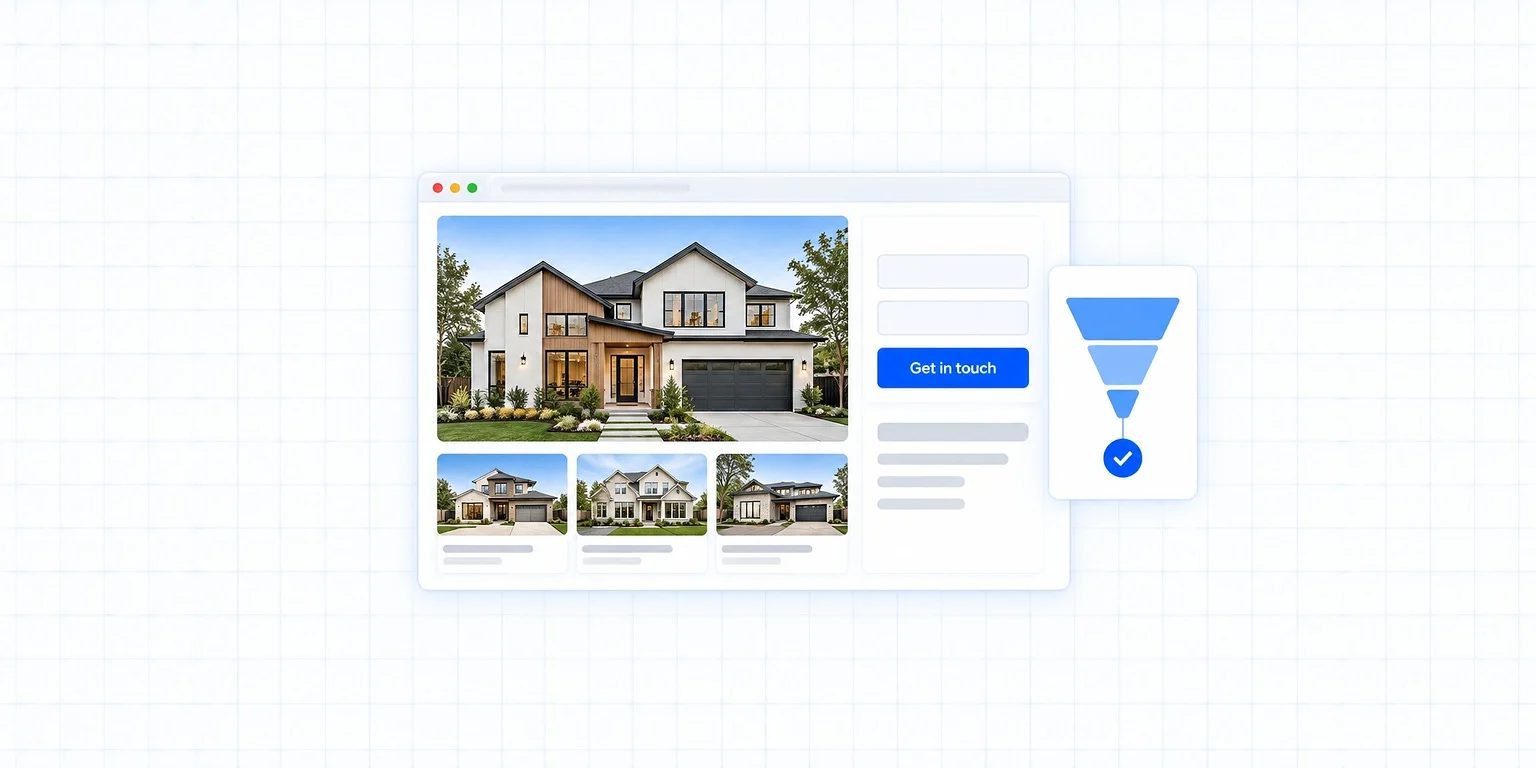
A high-converting website has to do more than exist. Most real estate sites are built to look respectable and then judged on whether the phone rings, which are two different standards. National Association of REALTORS research shows how much of the buyer journey is settled online before any contact is made.
Why a High-Converting Website Matters More Than Ever
Let’s face it, the real estate game has evolved. Gone are the days of window displays and cold calls. Buyers and sellers now rely on online listings, virtual tours, neighborhood insights, and intuitive mobile experiences to make decisions, often before they even talk to an agent.
Here’s what your real estate website should do (but many don’t):
- Showcase listings with high-quality visuals and MLS/IDX integration
- Load fast and look stunning on any device
- Include smart search and filtering features
- Offer lead capture tools like forms, chatbots, and scheduling
- Highlight local market trends and neighborhood profiles
- Build trust with testimonials, agent bios, and blog content

It should convert visitors into clients.
The Reaplex Real Estate Website Design Advantage
At Reaplex, we specialize in crafting high-performing websites tailored specifically for real estate professionals, brokers, agencies, and property developers. We don’t believe in cookie-cutter templates. We build custom solutions that speak your brand and drive real results.
Here’s what sets us apart:
- 🔍 SEO-Optimized from Day One
We build websites that search engines (and humans) love, helping you rank for your local keywords and get discovered organically. - 📱 Mobile-First & Lightning-Fast
Your clients are searching on the go. Our websites are fully responsive and optimized for speed, giving users the smoothest experience possible. - 🔗 MLS/IDX Integration
We integrate your site with MLS and IDX feeds, so your listings update automatically and clients can search with ease. - 🤖 Lead Capture Automation
We integrate smart forms, CRM connections, and chat features so new leads reach you quickly. - 🎨 Custom Real Estate Website Design That Builds Trust
Real estate is a relationship business, and trust starts with a sleek, professional site that reflects your expertise and personality.
Whether You’re an Agent or a Brokerage: We’ve Got You
We build for:
- Solo agents building a personal brand
- Small-to-midsize brokerages expanding their digital presence
- Real estate investors and property managers
- Luxury real estate brands needing a premium edge
What “High-Converting” Actually Means
A conversion is any moment a visitor takes a step that can lead to business: filling in a form, booking a call, requesting a home valuation, saving a search or tapping to call you. A high-converting website is simply one where a healthy share of the right visitors take one of those steps.
That definition matters, because it changes how you judge your site. Looks still count, but the real question is whether visitors who could become clients find a clear, easy reason to get in touch. A plain site that turns visitors into conversations will always beat a beautiful one that nobody contacts.
The Five Jobs of a High-Converting Website
Every high-converting real estate website does the same five jobs well. When one of them is weak, leads leak away no matter how strong the others are.
- Get found: appear when local buyers and sellers search, through local SEO, area pages and your Google Business Profile.
- Load fast: show the main content quickly on a phone, so visitors stay long enough to see what you offer.
- Earn trust: show who you are, where you work and what clients say about you.
- Capture the lead: give every visitor a clear, easy next step that fits what they came for.
- Connect and follow up: send every lead into your CRM, so you can reply quickly and keep in touch.

Start With a Home Page That Converts
Your home page is often the first page people see, and it has a few seconds to answer three questions: who you help, where you work and what the visitor should do next. A converting home page usually includes:
- A clear headline that names your area and the people you serve.
- One main call to action, such as searching homes or requesting a valuation, placed near the top.
- A short row of current listings or recent sales.
- Two or three specific reviews near your contact options.
- A tap-to-call button and a short form that are easy to reach on a phone.
- A fast first load, especially on mobile.

Read your home page as a stranger would. If you cannot tell within a few seconds what to do next, neither can your visitors.
Match Calls to Action to Each Visitor
Different visitors want different things, so a single “Contact us” button cannot serve them all. A high-converting website offers a next step that fits each audience:
- Buyers: search homes, save a search, get new-listing alerts or book a showing.
- Sellers: request a home valuation or a listing consultation.
- Relocating families: download an area guide or book a call about neighborhoods.
- Investors and developers: request a market briefing or discuss a project.
Place each call to action where it makes sense. A seller’s page should lead to a valuation, a listing page to a showing request and a neighborhood page to an alert for that area.
Build Forms That People Actually Finish
Forms are where most conversions happen, and where many are lost. Every extra field gives a visitor another reason to stop. Ask only for what you need to reply, usually a name, an email or phone number and an optional message.
- Use clear labels and a specific button, such as “Request my valuation” rather than “Submit”.
- Tell people what happens next and how quickly you will reply.
- Pass useful context automatically, such as the listing or page the visitor was on.
- Add spam protection that does not slow real visitors down.
Test every form yourself regularly. A broken form or a notification that lands in spam can quietly cost you leads for months.
Make Speed and Mobile a Priority
Many buyers browse on their phones, often in short moments between other things. If your pages load slowly or the buttons are hard to tap, they leave before they ever see your offer. Google also measures real-world speed through Core Web Vitals and uses it as one of many signals.
Compress images, load photos as visitors scroll, keep plugins and scripts to a minimum and choose good hosting. Our guide to website speed optimization explains what to check first.
Show Proof That Builds Trust
People contact agents they trust. A high-converting website makes trust visible: a friendly, recent photo, an About page that tells your story, specific reviews from real clients, the areas you know best and homes you have helped sell.
Put proof where decisions happen. Reviews beside a form are more persuasive than the same reviews on a page few people visit. Link to your Google reviews so visitors can see they are genuine.
Keep Listings on Your Own Site
Listings are the most visited pages on most agent websites. When property search sends buyers to another site, conversions go with them. With IDX on your own domain, every listing page carries your branding, your forms and your phone number, and buyers keep searching with you.
Give each listing page a short question form beside the photos, a clear showing button and a way to save the home or set up alerts.
Give Sellers a Page Built for Them
Many real estate websites are built almost entirely around property search, which leaves sellers with nowhere obvious to go. Seller leads are often among the most valuable a website can produce, so they deserve their own path.
Create a dedicated page that explains how you price a home, how you prepare it for market, where you promote it and how you handle offers. Add homes you have helped sell, reviews from past sellers and a simple valuation request. Link it from your main menu and your home page, so a homeowner can find it in one click.
Use Content That Moves Visitors Toward Contact
Blog posts and guides bring visitors to your site, but they only help conversion when they lead somewhere. End every article with a next step that fits the topic: a buyer guide leads to a saved search, a selling article leads to a valuation, and a neighborhood guide leads to listings in that area.
Write about your actual market in plain language. Local, useful content shows visitors you know the area, and that expertise is a strong reason to get in touch.
Make the Site Easy for Everyone to Use
An accessible website converts better because more people can use it comfortably. Readable text, strong contrast, descriptive alt text on images, clearly labeled form fields and buttons that work with a keyboard all remove small obstacles. Many of the same choices also make the site clearer for search engines.
Try completing your own contact form on a phone, with large text turned on. Anything that feels awkward to you is costing you conversions.
Bring Visitors Who Are Ready to Convert
Conversion depends on who arrives. Visitors searching for homes or agents in your area convert far better than a general audience. Local SEO, well-built neighborhood pages and a complete Google Business Profile attract exactly those people. Our page on real estate SEO for agents covers the foundations.
Connect Every Lead to Your CRM
A conversion is only valuable if someone follows up. Send every form, call click and booking into your CRM, tagged with where it came from, so you can reply quickly and track which pages bring clients. Reaplex connects websites to CRMs such as Follow Up Boss, BoldTrail (kvCORE), Lofty, Sierra Interactive, GoHighLevel, HubSpot and Salesforce. See CRM integration for how it works.
Measure, Test and Keep Improving
A high-converting website is never finished. Track every form submission, call click and booking as a conversion in Google Analytics, then review the numbers monthly:
- Which pages bring visitors, and which of them produce leads.
- Which traffic sources bring leads, not just visits.
- Where visitors leave before converting.
Change one thing at a time, such as a headline, an offer or the position of a form, and watch the results over a few weeks. Small, steady improvements add up to a site that keeps converting more of the visitors you already have.
Plan Conversions Before the Design
The most effective websites are planned around conversions from the start, not decorated first and fixed later. Before any design work, decide who your main visitors are, what you want each of them to do and which page will lead them there. That plan shapes the menu, the order of sections on each page and where every form and button sits.
Planning this way also keeps the site focused. Every page has a purpose, and anything that does not help a visitor find a home, trust you or contact you can be simplified or removed.
Keep the Site Current
Returning visitors notice when nothing changes. Add new reviews as they arrive, remove sold listings promptly, refresh area pages a few times a year and publish local updates regularly. A site that clearly looks active gives visitors confidence that you are available and worth contacting today.
Common Conversion Mistakes on Real Estate Websites
- No clear next step on the home page or listing pages.
- Long forms that feel like an application.
- Slow pages full of uncompressed photos.
- Hidden contact details that make visitors hunt for a phone number.
- Old content that makes the site look inactive.
- Leads left in an inbox instead of a CRM with alerts.
Most sites have one or two of these problems rather than all of them. Start with the one that affects the most visitors, usually the home page or listing pages, fix it, and measure the difference before moving on. Each fix makes the rest of your marketing work harder for you.
Frequently Asked Questions About High-Converting Real Estate Websites
What is a good conversion rate for a real estate website?
It varies widely with your market, your traffic sources and what you count as a conversion, so comparing yourself with a single industry number can mislead. Track your own rate month by month and aim for steady improvement.
How do I know if my website is converting?
Set up conversion tracking for every form, call click and booking. If visitors arrive but few of them take any of those steps, the site is not converting as well as it could.
Is a custom website more converting than a template?
Not automatically. What matters is whether the site is fast, clear, trustworthy and built around your visitors’ next steps. A custom build makes it easier to design every page around conversion and to own and change the site as you grow.
Do chatbots improve conversions?
They can, if someone follows up quickly on what they collect. A short form, a visible phone number and fast personal replies often convert just as well.
How long does it take to build a high-converting website?
A Reaplex build usually takes 2 to 4 weeks, depending on the number of pages, integrations and how quickly content is ready.
Can I improve conversions without a full redesign?
Often, yes. Clearer calls to action, shorter forms, better reviews, faster images and a CRM connection can all be added to an existing site. A rebuild makes sense when the platform itself is slow, hard to change or not yours.
Which page matters most for conversions?
Usually the home page and your listing pages, because they get the most visits. After those, a seller’s page with a valuation request and well-built neighborhood pages tend to produce the most valuable leads.
Should my phone number be on every page?
Yes. Many visitors would rather call or text than fill in a form, especially on a phone. A tap-to-call number in the header and beside each form makes it easy for them.
Does a brokerage website need different conversion features?
Often, yes. A brokerage site may need agent profiles, lead routing to the right agent and recruiting pages alongside buyer and seller paths. Team routing can be scoped as part of the build.
Do I own the website Reaplex builds?
Yes. Reaplex builds on WordPress you own, so your pages, your content and your leads stay yours. You can keep improving conversions over time without being tied to a platform you cannot change.
How much does a high-converting real estate website cost?
At Reaplex, the Launch package starts at $685 as a one-time build, covering up to 10 pages designed for you, basic IDX and MLS integration, lead-capture forms and SEO foundations, on WordPress you own. Larger custom builds are quoted on a free consultation, and care plans from $99 a month cover updates, backups and small edits.
Your Website Should Work as Hard as You Do
Think of your website as your digital office, open 24/7. While you’re showing properties or closing deals, it should be capturing leads, nurturing prospects, and making you look like the top-tier pro you are.
With Reaplex, you get more than just a pretty site, you get a growth engine.
Want this done for your website?
Book a free, no-pressure call and I’ll map exactly how your real estate website can capture more leads, and what it costs to own it.

Asraful has built 200+ real estate websites with IDX and MLS integration, rated 5.0 across 180+ verified reviews. He writes about owning your website, lead generation and getting found on Google.
More about Reaplex