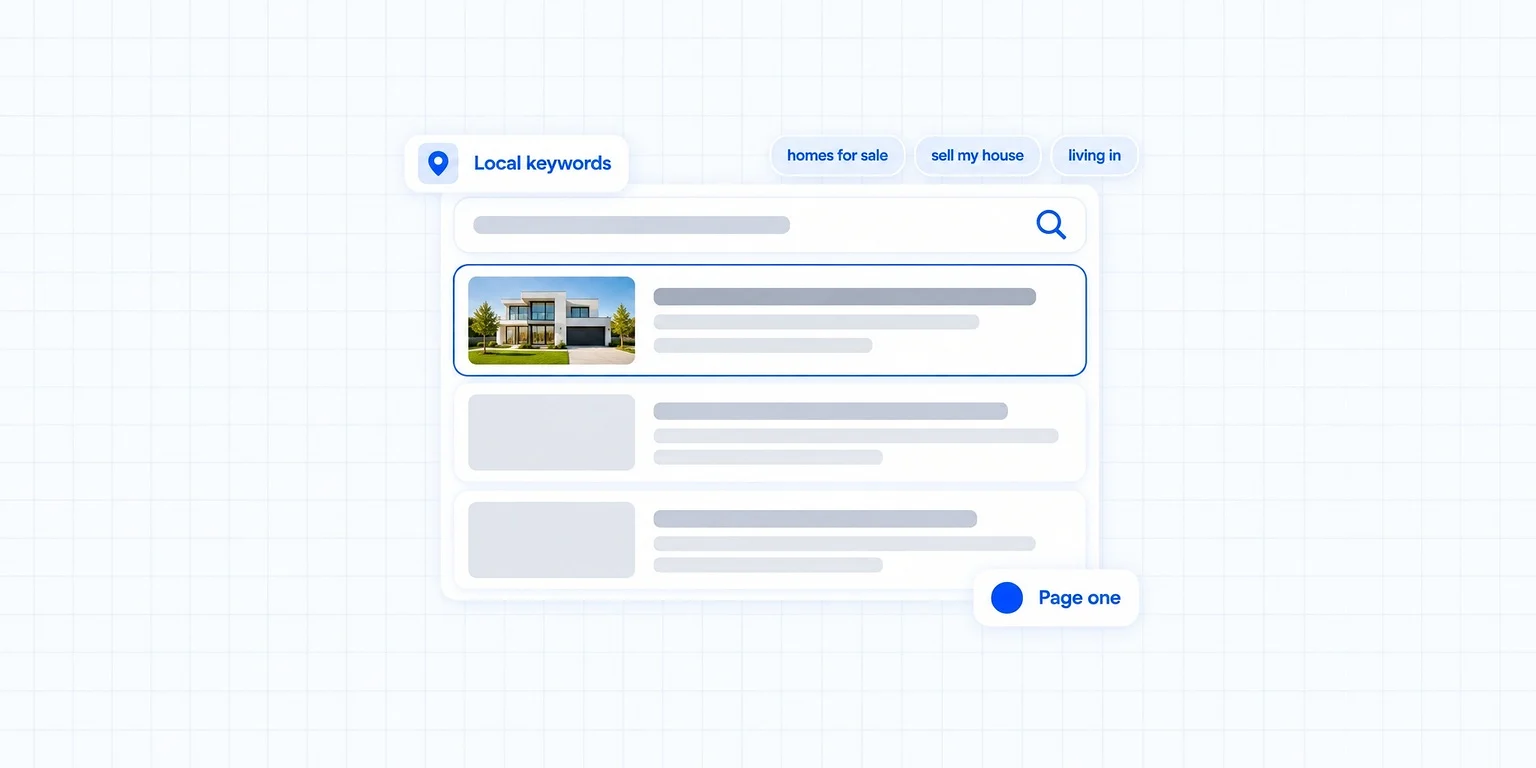
Quick answer: The best real estate SEO keywords for an agent are local and specific: “[neighborhood] homes for sale”, “homes for sale in [town] with a pool”, “[town] real estate agent”, “sell my house in [town]”, “[town] market report”. They are less competitive than broad terms like “real estate”, and the people searching them are closer to calling an agent. Find them with free tools (Google’s own autocomplete and “People also ask”, plus your Search Console data), group them by intent, and give each group one page on your website.
Keyword research is one of the easiest SEO steps to skip, and one of the most useful to do. They write a home page, a bio and a few blog posts, and hope Google works out who they are for. Choosing real estate SEO keywords deliberately is how you tell Google, and buyers and sellers, exactly which searches you should answer. This guide shows you the keyword types that matter for agents, a list of templates you can adapt to your market, how to find the real phrases people use, and how to turn them into pages that rank.
What This Guide Covers
- How Google wants you to think about keywords
- The 5 types of real estate SEO keywords
- Real estate SEO keywords you can adapt
- How to find the real phrases people use
- Mapping keywords to pages
- Long-tail real estate SEO keywords
- A worked example
- A 30-day plan
- Using keywords on the page, the right way
- Keywords beyond your website
- Common keyword mistakes
- Frequently asked questions
How Google Wants You to Think About Keywords
Google’s own SEO Starter Guide keeps it simple. It advises you to “think about the words that a user might search for to find a piece of your content”, and to write content “your readers will find helpful and reliable”. It also warns that “keyword stuffing is against Google’s spam policies.”
That is the whole philosophy of real estate SEO keywords in three lines. Know the phrases your clients use. Write pages that genuinely answer them. Use the words naturally, not repeatedly. Everything below is a practical way to do those three things.
The 5 Types of Real Estate SEO Keywords
Real estate SEO keywords fall into five groups. Each one attracts a different kind of visitor, and needs a different kind of page.
1. Buyer search keywords
“Homes for sale in [town]”, “[neighborhood] condos”, “3 bedroom homes in [town]”. These people are looking at listings. They belong on IDX search pages and neighborhood pages with live listings.
2. Seller keywords
“Sell my house in [town]”, “what is my home worth [town]”, “best time to sell a house in [state]”. These are the most valuable real estate SEO keywords an agent can rank for, because sellers are the most valuable clients. They belong on your seller page, your home value page and seller guides.
3. Agent keywords
“[town] real estate agent”, “realtor near me”, “best realtor in [neighborhood]”. People searching these want an agent now. Your home page, about page and Google Business Profile compete for them.
4. Area and lifestyle keywords
“Moving to [town]”, “living in [neighborhood]”, “[town] neighborhood guide”, “[town] schools”. These visitors are earlier in their journey, often relocating. Neighborhood guides and relocation pages win them.
5. Market keywords
“[town] housing market”, “[town] home prices”, “is now a good time to buy in [town]”. These attract both buyers and sellers who are thinking ahead. Regular market updates on your blog answer them.

Real Estate SEO Keywords You Can Adapt
Replace the brackets with your towns, neighborhoods and property types. These are patterns, not guaranteed rankings; your job is to check which variations people in your market actually search.
For buyers
- homes for sale in [town]
- [neighborhood] homes for sale
- [town] condos for sale
- homes for sale in [town] with a pool
- new construction homes in [town]
- [town] waterfront homes
- homes for sale near [school or landmark]
For sellers
- sell my house in [town]
- what is my home worth in [town]
- [town] home value
- how to sell a house in [state]
- best time to sell a house in [town]
- listing agent [town]
For finding an agent
- [town] real estate agent
- [town] realtor
- best real estate agent in [neighborhood]
- [town] luxury real estate agent
- first-time home buyer agent [town]
For areas and moving
- moving to [town]
- living in [neighborhood]
- best neighborhoods in [town]
- [town] vs [nearby town]
- cost of living in [town]
For the market
- [town] housing market
- [town] home prices
- [town] real estate market forecast
- are home prices dropping in [town]
Notice that almost every one of these real estate SEO keywords includes a place. That is the single biggest advantage an individual agent has over national portals: you can be the most specific, helpful page for your own streets.
How to Find the Real Phrases People Use
You do not need paid tools to start. These free methods give you real search behavior.
Google autocomplete
Type the start of a phrase into Google, such as “homes for sale in [town]”, and look at the suggestions. They are based on what people actually search. Add a letter after your phrase (“homes for sale in [town] a”, “b”, “c”) to see more.
“People also ask” and related searches
Search your main phrase and read the “People also ask” questions and the related searches at the bottom of the page. Each question is a ready-made heading or FAQ for one of your pages.
Google Search Console
If your site is connected to Search Console, the Performance report shows the real queries people used to find you, how often you appeared, and your average position. Phrases where you appear on page two are your quickest wins.
Your own clients
Ask new clients what they searched before they found you. Write down their exact words. Real estate SEO keywords that come from real conversations are often ones no tool shows you.
Your competitors
Search your top phrases and look at the pages that rank. What do they cover? What do they miss? Your page should answer the question better, not just repeat the keyword more.

Mapping Real Estate SEO Keywords to Pages
The most common mistake is writing five pages that all chase the same phrase. Google then has to guess which one to show, and often shows none. The fix is a simple keyword map: one main keyword group per page.
- Home page: “[town] real estate agent” and close variations.
- Buy page and IDX search: “homes for sale in [town]”.
- Each neighborhood page: “[neighborhood] homes for sale” plus “living in [neighborhood]”.
- Sell page: “sell my house in [town]”.
- Home value page: “what is my home worth in [town]”. I covered how to build one in home value landing page.
- Blog posts: questions and market topics, one main question per post.
Write the map down in a simple spreadsheet: page, main keyword, two or three variations, and the date you last updated it. It takes an hour and saves you from competing with yourself for years.

Long-Tail Real Estate SEO Keywords: Where Agents Win
Long-tail real estate SEO keywords are longer, more specific phrases: “single story homes for sale in [neighborhood]”, “townhomes near [school] under [price]”, “is [neighborhood] a good place to live”. Each one is searched less often than a broad term, but together they make up a large share of real searches, and they are far easier to rank for.
They are also more valuable per visitor. Someone searching “homes for sale” is browsing. Someone searching “4 bedroom homes with a pool in [neighborhood]” knows what they want, and the agent who shows them those homes is the agent they call.
Three good sources of long-tail real estate SEO keywords:
- The features buyers filter for in your market: pools, acreage, single story, waterfront, new construction, a home office.
- The questions you answer every week on the phone, from “how long does closing take in [state]” to “what are HOA fees like in [neighborhood]”.
- The comparisons people make: “[neighborhood A] vs [neighborhood B]”, “buy or rent in [town]”.
A neighborhood page can cover several of these at once with sections on homes, schools and lifestyle. A blog post can answer one question properly. Both build the same thing: proof to Google that you are the local expert.
A Worked Example: One Agent’s Keyword Map
Here is how a keyword map might look for an agent who works three neighborhoods in one town. The brackets stand for real names in your market.
- Home page: “[town] real estate agent”, “[town] realtor”.
- Buy page: “homes for sale in [town]”, “[town] real estate listings”.
- [Neighborhood A] page: “[neighborhood A] homes for sale”, “living in [neighborhood A]”.
- [Neighborhood B] page: “[neighborhood B] homes for sale”, “[neighborhood B] schools”.
- [Neighborhood C] page: “[neighborhood C] homes for sale”, “new construction in [neighborhood C]”.
- Sell page: “sell my house in [town]”, “listing agent [town]”.
- Home value page: “what is my home worth in [town]”.
- Blog: “[town] housing market” (monthly update), “moving to [town]”, “[neighborhood A] vs [neighborhood B]”, “best time to sell a house in [town]”.
Eleven pages and posts, each with its own job, and no two chasing the same phrase. That is a small, focused set of real estate SEO keywords that a solo agent can realistically rank for, and every page links to the others where it helps the reader.
A 30-Day Real Estate SEO Keywords Plan
If you are starting from nothing, this is a realistic month.
- Week 1: list your areas and run each through autocomplete for buyer, seller, agent, area and market phrases. Choose your main real estate SEO keywords for each page.
- Week 2: fix your existing pages first. Update titles, first paragraphs, headings and meta descriptions to match the map. Merge or redirect pages that compete for the same phrase.
- Week 3: write or improve one neighborhood page properly, with real local detail, recent sales and links to your search and home value pages.
- Week 4: publish one market update and one answer to a common question, and link both to the right main pages.
Then repeat weeks 3 and 4 every month. Consistency beats volume: one genuinely useful local page a month will outperform a burst of thin ones.
Using Keywords on the Page, the Right Way
Once each page has its main phrase, use it where it helps readers and search engines understand the page, and nowhere it sounds forced:
- The page title and main heading, near the start.
- The first paragraph, so the topic is clear immediately.
- One or two subheadings, where they fit naturally.
- Image alt text, describing what the image shows.
- The URL, short and readable: /homes-for-sale-[town]/.
- The meta description, which is the snippet people read in search results.
Then write the rest of the page for people. Recent sales, schools, commute times, what the streets are like, your own opinion. That is what makes a page more helpful than the portals, and it naturally includes the related words Google looks for. For the technical side, see how SEO-friendly website design affects rankings.
Real Estate SEO Keywords Beyond Your Website
Your keyword map should not stop at your own site. The same real estate SEO keywords belong, naturally, in a few other places that feed local search:
- Your Google Business Profile. Use your main area and service phrases in the description and services, in plain sentences, never in your business name. The setup is in Google Business Profile for real estate agents.
- Your listing descriptions. Name the neighborhood and the features buyers search for, such as “single story” or “walk to [school]”.
- Your social posts and videos. Titles and captions that name the place help those posts surface in search too.
- Reviews. When clients mention the neighborhood in their own words, it reinforces what you serve. Never script their wording; just ask them to describe their experience.
Everywhere the same rule applies: say the place and the service clearly, once, in a sentence a person would actually write.
Common Real Estate SEO Keyword Mistakes
- Chasing “real estate” or “homes for sale”. Broad terms are dominated by national portals. Go local and specific.
- Keyword stuffing. Repeating a phrase in every sentence reads badly and, as Google says, is against its spam policies.
- Many pages for one phrase. Pick one page per keyword group.
- Doorway pages. Dozens of near-identical town pages with the name swapped. Write real content for each area or do not publish the page.
- Ignoring sellers. Most agent sites target buyers only. Seller real estate SEO keywords are less crowded and more valuable.
- Never updating. Market pages with last year’s numbers lose trust and rankings.
Frequently Asked Questions About Real Estate SEO Keywords
What are the best real estate SEO keywords?
Local, specific phrases tied to an action: “[neighborhood] homes for sale”, “sell my house in [town]”, “[town] real estate agent”. They are easier to rank for than broad terms and bring visitors who are closer to hiring an agent.
How many keywords should a page target?
One main keyword group per page, with a few natural variations. If you want to rank for a different phrase, it usually deserves its own page.
Do I need paid keyword tools?
Not to start. Google autocomplete, “People also ask”, related searches and your own Search Console data show what people really search. Paid tools add search volume estimates, which help as your site grows.
How do I find neighborhood keywords?
Type each neighborhood name into Google followed by “homes”, “real estate” and “living in”, and note the suggestions. Then check whether the top results are portals or local pages; local pages mean you can compete.
How long does it take to rank for real estate keywords?
It varies with competition and your site’s history. Local, specific phrases can move within weeks to months; broad, competitive terms take much longer, and some will always belong to the portals.
Do real estate SEO keywords change over time?
The core phrases stay stable, but new neighborhoods, developments and market conditions create new searches. Review your keyword map every few months, check Search Console for new queries, and add or refresh pages when a new area or question starts appearing.
Should I target keywords on my blog or my main pages?
Both, for different keywords. Main pages target the core service and area phrases. Blog posts target questions and market topics, and link back to the main pages.
What I Would Do
Spend one hour this week: list your five most important areas, run each through autocomplete for buyer, seller and lifestyle phrases, and write a one-page keyword map. Then check that every main phrase has exactly one page on your site. That hour will shape every page and post you write after it.
If you want the site built around that map from the start, I offer real estate SEO for agents as part of every build: local pages, seller pages and clean technical foundations. 200+ sites, a 5.0 rating from 180+ verified reviews. Get a free website audit to see where you stand.
Want this done for your website?
Book a free, no-pressure call and I’ll map exactly how your real estate website can capture more leads, and what it costs to own it.

Asraful has built 200+ real estate websites with IDX and MLS integration, rated 5.0 across 180+ verified reviews. He writes about owning your website, lead generation and getting found on Google.
More about Reaplex