Quick answer: A home value landing page asks a homeowner for one thing, their address, and gives them something they want in return: an estimate of what their home is worth, followed by a proper market analysis from you. It works because sellers are curious long before they are ready to call an agent. The pages that convert ask for the address first, set honest expectations about automated estimates, promise a real analysis, and get followed up within minutes. This guide covers how to build one, what to write on it, and how to turn the leads into listings.
Seller leads are the most valuable leads an agent gets, and the hardest to find. Buyers announce themselves by searching listings. Sellers stay quiet until they are ready to interview agents, and by then they have often already picked one. A home value landing page is how you meet them earlier. I build these pages into most of the agent sites I make, including the Homebot valuation on Jesse Carlson’s site, and the difference between one that works and one that does not usually comes down to a few details.
What This Guide Covers
- Why a home value landing page works
- The anatomy of a home value landing page that converts
- Automated estimates: be honest about accuracy
- Instant estimate, manual analysis, or both?
- Headlines and copy that work
- A sample page, section by section
- How to measure it
- Getting homeowners to the page
- Follow-up: where listings are won
- Common mistakes
- Frequently asked questions
Why a Home Value Landing Page Works
Almost every homeowner wonders what their house is worth. Very few want to call an agent to ask, because a call feels like a commitment. A home value landing page removes that barrier. Typing an address is low effort and low risk, and the reward is immediate.
For you, the address is the most useful piece of information a seller lead can give. It tells you the property, the neighborhood, often the likely equity, and how long they have owned it. A name and email from a generic contact form tells you none of that.
There is also timing. People who ask what their home is worth are often months away from listing. That is good news, not bad: it gives you months to become the agent they already trust when the time comes. A home value landing page is the start of that relationship, not the end of a sale.

The Anatomy of a Home Value Landing Page That Converts
Every good home value landing page I have built or reviewed has the same eight parts.
- A headline that promises the outcome. “What is your home worth in [Town]?” beats “Free home valuation”. Name the place.
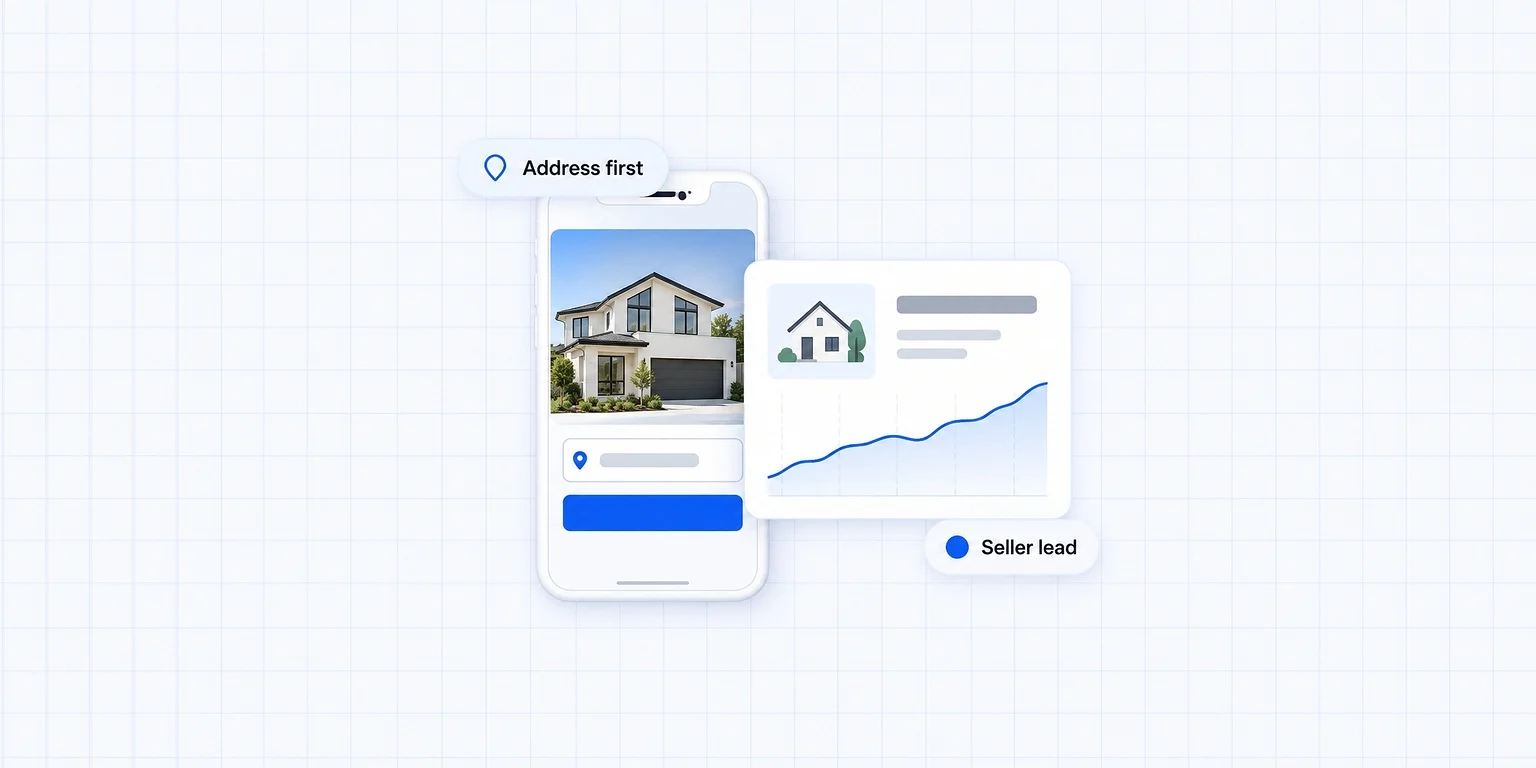
- The address field first, on its own. One field, one button. Asking for name, email and phone before the address cuts responses, because it asks for commitment before giving anything back.
- Contact details second. After the address, ask where to send the result: name, email, and phone if you will call. People who have typed their address are far more willing to finish.
- An honest expectation line. Say that an automated estimate is a starting point and that you will follow up with an analysis based on recent sales nearby. It builds trust and sets up your call.
- What they will receive, and when. “A personal market analysis within 24 hours” is concrete. “We will be in touch” is not.
- Local proof. Two or three recent sales you handled in the area, and a couple of seller reviews. Proof that you know their street.
- A privacy line. One sentence on how you use their details. If you will text them, ask for consent clearly and follow your broker’s guidance on it.
- A thank-you page with a next step. Do not end on “Thanks!” Offer to book a 15-minute call, or show recent sales in their neighborhood while they wait.
Notice what is missing: navigation menus, a home search, links to your blog. A home value landing page has one job. Everything that does not help with that job is a way out.
Automated Estimates: Be Honest About Accuracy
Many home value landing pages show an instant automated estimate. That is useful, and it is also where you can build or lose trust in the first ten seconds.
Zillow is unusually open about this. On its own Zestimate page, Zillow says the nationwide median error rate is 1.77% for homes on the market and 7.20% for off-market homes, and that the Zestimate “is not an appraisal”. The homeowners using your home value landing page are almost all off-market. On a $500,000 home, a 7.20% error is $36,000, and half of all off-market estimates miss by more than that.
That is not a reason to avoid automated estimates. It is the reason your home value landing page should promise more than a number. Say plainly that the instant estimate is a starting point and that your analysis, based on recent sales, condition and upgrades, will be more accurate. The gap between an algorithm and a local agent is exactly the value you are offering.

Instant Estimate, Manual Analysis, or Both?
There are three ways to build the result side of a home value landing page.
Instant estimate only
A valuation tool shows a number immediately. Fast and satisfying for the visitor, and it scales. The risk is that a visitor gets their number and leaves without ever talking to you, and a number that looks wrong can cost you credibility.
Manual analysis only
The page collects the address and promises a personal analysis by email or phone. Fewer people may fill it in, because there is no instant reward, but every lead expects to hear from you, which makes the follow-up conversation natural.
Both, which is what I usually recommend
Show an instant range, then offer a free personal analysis to refine it. The visitor gets something now and a reason to talk to you. Tools such as Homebot also send homeowners regular updates about their home’s value and equity, which keeps you in touch for months. That is the setup on Jesse Carlson’s site, one of the real estate agent website examples I walked through.
Whichever you choose, the home value landing page should live on your own domain, not on a vendor’s page, so that the traffic, the trust and the search value stay with you.
Headlines and Copy That Work on a Home Value Landing Page
Write like a local agent, not like a software company. Some headlines that work, adapted to your area:
- “What is your [Neighborhood] home worth today?”
- “See what homes like yours sold for this month.”
- “Thinking of selling in [Town]? Start with your number.”
Under the headline, one or two sentences: what they get, how fast, and that there is no obligation. Then the address field. Under the form, the expectation line and your proof. That is enough copy. A home value landing page that reads like a brochure is a home value landing page people scroll past.
A Sample Home Value Landing Page, Section by Section
Here is a complete page you can adapt. Replace the brackets with your own details, and keep it to roughly this length.
Headline: What is your [Neighborhood] home worth today?
Subheading: Enter your address for an instant estimate, then get a personal market analysis from me within 24 hours. No obligation, no pressure.
Form, step one: a single address field and a button that says “See my estimate”.
Form, step two: “Where should I send your full analysis?” Name, email, and mobile number, with a clear consent line if you will text.
Expectation line: Online estimates are a useful starting point, but they cannot see your kitchen, your renovations or the sale next door last month. My analysis can.
Proof: Three recent sales you handled nearby, each with a photo, the street name and a short line, and two short seller reviews.
About you, in two sentences: who you are, how long you have worked the area.
Privacy line: I use your details only to send your analysis and occasional local market updates. Unsubscribe any time.
That is the whole home value landing page. It is short because its only job is to get an address and earn a conversation.
How to Measure Your Home Value Landing Page
Three numbers tell you whether the page is working, and all of them are easy to track.
- Visitors to completed requests. Of everyone who lands on the page, how many finish both steps? If many start but few finish, the second step is asking for too much.
- Requests to conversations. Of everyone who requests a value, how many do you actually speak to? If that number is low, look at your follow-up speed before you change the page.
- Conversations to listing appointments, over six to twelve months. This is the number that justifies the effort, and it only shows up if you keep in touch.
Change one thing at a time, such as the headline or the button text, and give each version a few weeks before you judge it. Small pages like this improve steadily when you measure them.
Getting Homeowners to Your Home Value Landing Page
A great page with no visitors does nothing. These are the channels that work for agents:
- Your own website. Link to the home value landing page from your navigation, your seller page and the end of every neighborhood page.
- Your Google Business Profile. Mention it in posts and link to it. I covered the profile setup in Google Business Profile for real estate agents.
- Paid ads to homeowners in your farm area, on Google or Facebook, sending people straight to the page.
- Print. Postcards and door hangers with a short link or QR code to the page.
- Your sphere. An email to past clients once a year: “Curious what your home is worth now?”
Follow-Up: Where Listings Are Won
The home value landing page gets the address. Follow-up gets the listing. A simple sequence:
- Within minutes: call or text to confirm you received the request and ask one question about the home (recent updates, timing). Speed matters; the first agent to respond with something useful sets the tone.
- Within 24 hours: send the personal analysis you promised, with three or four comparable sales and a short note in your own words.
- Monthly after that: a short market update for their area, or an automated home value update if your tool provides one.
- When they are ready: they already know you, have your analysis, and have heard from you every month. The listing appointment is half won.
All of this depends on leads reaching you fast. If your home value landing page sends leads to an inbox you check once a day, connect it to your phone or CRM. That is what CRM integration is for.

Common Home Value Landing Page Mistakes
- Asking for everything at once. Name, email, phone, bedrooms, bathrooms and timeline before the address. Ask for the address first.
- Promising precision. “Get your exact home value” sets you up to disappoint. Promise a starting point and an expert analysis.
- Hosting it on someone else’s domain. You lose the search value and the brand.
- A full website menu on the page. Every link out is a lead lost.
- Slow follow-up. A seller lead contacted the next day has often already heard from someone else, or lost interest.
- No local proof. Generic stock photos and no recent sales give a homeowner no reason to choose you.
Building a Home Value Landing Page on Your Own Site
On an owned WordPress site, a home value landing page is usually a dedicated page with a two-step form, connected to your valuation tool (if you use one) and to your CRM. It should load fast on a phone, because most homeowners will open it from a text, an ad or a QR code. Many IDX providers also offer a valuation or market report page you can place on your domain.
If you are on a rented platform, check whether a home value page is included or sold as an add-on, and whether the leads go to your CRM or stay inside the platform. I set out how these tools fit together in turning your website into a lead generation machine.
Frequently Asked Questions About Home Value Landing Pages
What is a home value landing page?
It is a single-purpose page that asks a homeowner for their address and offers an estimate of their home’s value, usually followed by a personal market analysis from the agent. Its job is to generate seller leads.
Do home value landing pages actually get listings?
They get seller leads, many of whom are months from listing. Whether those become listings depends on your follow-up: a fast response, a genuinely useful analysis and regular contact until they are ready.
Should I show an automated estimate?
It helps, as long as you present it honestly. Zillow itself reports a 7.20% median error for off-market homes. Show a range, call it a starting point, and offer your own analysis to refine it.
What fields should the form have?
Address first, on its own. Then name, email and phone. Anything else, such as timeline or upgrades, is better asked in your follow-up conversation.
Where should I send traffic from?
Your own website, your Google Business Profile, ads to homeowners in your farm area, print with a QR code, and an annual email to your sphere.
How is a home value landing page different from a seller page?
A seller page explains how you sell homes: your process, marketing and results. A home value landing page has a narrower job, which is to get the address. Link them together: the seller page should send people to the home value landing page, and the thank-you step can point back to the seller page for anyone who wants to know more about working with you. For the wider picture of finding sellers online, see why a real estate website is not getting leads.
Can I use one home value landing page for several towns?
You can, but a page per town or neighborhood usually converts better, because the headline and the proof can be specific to that place, and each page can rank for its own local search.
What I Would Do
Build one home value landing page for your strongest area this month: address first, honest expectations, three recent local sales, and a promise of a personal analysis within 24 hours. Send your sphere to it, put it in your Google Business Profile, and follow up every lead within minutes. Then add a page for your next area.
If you want it built properly on your own domain, connected to your CRM, I build lead generation websites for agents with seller tools like this built in. 200+ sites, a 5.0 rating from 180+ verified reviews, and most go live in 2 to 4 weeks. Book a free consultation.
Want this done for your website?
Book a free, no-pressure call and I’ll map exactly how your real estate website can capture more leads, and what it costs to own it.

Asraful has built 200+ real estate websites with IDX and MLS integration, rated 5.0 across 180+ verified reviews. He writes about owning your website, lead generation and getting found on Google.
More about Reaplex