Quick answer: A real estate team website has to do three jobs a solo agent site does not: sell the team as one brand, give each agent a profile clients can trust, and route every lead to the right agent within minutes. The best team sites have one strong home page, buyer and seller paths, a profile page for each agent, IDX search on the team’s own domain, lead routing into a shared CRM, and a careers page for recruiting. This guide covers what to include, how to structure it, how to handle leads fairly, and the mistakes that make team websites underperform.
A team is a different business from a solo agent, and its website should reflect that. Clients are hiring a group of people with a system, not a single face. Agents on the team need their own credibility. The team leader needs leads distributed fairly and tracked. A real estate team website that is just a solo site with a “Meet the team” page bolted on fails at all three. I have built sites for teams of different sizes, including SoFlo Homes Group in South Florida, and the same structure keeps proving itself. You can see how we approach them on our websites for brokers and teams page.
What This Guide Covers
- The three jobs of a real estate team website
- The pages every team website needs
- Agent profile pages that build trust
- Lead routing: fast, fair and tracked
- One team brand, many agents
- Content strategy for a team website
- Using the website to recruit agents
- The home page, section by section
- A simple launch plan
- How to measure it
- Common team website mistakes
- What a team website costs
- Frequently asked questions
The Three Jobs of a Real Estate Team Website
1. Sell the team
Clients choose a team because it offers more than one agent can: coverage, specialists, availability, a proven process. The home page has to make that case in seconds. SoFlo Homes Group’s site, one of the real estate agent website examples I walked through, introduces the staging, media, PR, marketing and transaction specialists behind each sale, so sellers see the whole operation rather than one agent with some headshots underneath.
2. Make every agent credible
When a lead is routed to an agent, that client will look the agent up. A proper profile page with their photo, areas, specialties, reviews and contact details makes the handoff feel natural rather than random.
3. Route leads fast and fairly
A real estate team website generates leads for several people. Each enquiry needs to reach the right agent within minutes, and the team leader needs to see who got what and what happened next. That is a system, not a contact form.

The Pages Every Real Estate Team Website Needs
- Home page: who the team helps, where, and why a team is better for them. One clear next step for buyers and one for sellers.
- Buy: IDX search on the team’s own domain, with saved searches and listing alerts.
- Sell: the team’s selling process, marketing and results, with a home value request.
- Meet the team: the roles and how they work together, linking to each agent’s profile.
- Agent profiles: one page per agent (more below).
- Areas: a page for each neighborhood or town the team covers.
- Results and reviews: recent sales and client reviews, filterable by agent if possible.
- Careers: for recruiting agents (more below).
- Contact: with routing behind it, not one shared inbox.
Agent Profile Pages That Build Trust
Agent profiles are the most neglected part of most real estate team website builds, and among the most visited. A client who has just been introduced to an agent wants reassurance. A good profile page includes:
- A professional photo, consistent in style with the rest of the team.
- Their role on the team and the areas and client types they focus on.
- A short, personal introduction written in their voice.
- Their own reviews and recent transactions.
- Direct contact details and a booking link.
- Required license and brokerage details, as your state and MLS rules require.
Profiles also help search. An agent who is the team’s specialist for a neighborhood can have that neighborhood on their profile, linking to the area page, so searches for that area find both.
Lead Routing: Fast, Fair and Tracked
This is where a real estate team website earns its keep or wastes leads. Common routing methods:
- Round robin: leads go to agents in turn. Simple and fair, good for teams of similar agents.
- By area: leads for a neighborhood go to the agent who covers it.
- By type: seller leads to listing specialists, buyer leads to buyer agents.
- By source: a lead from an agent’s own profile page goes to that agent.
- First to claim: all agents are notified and the first to accept takes it, with a fallback if nobody responds.
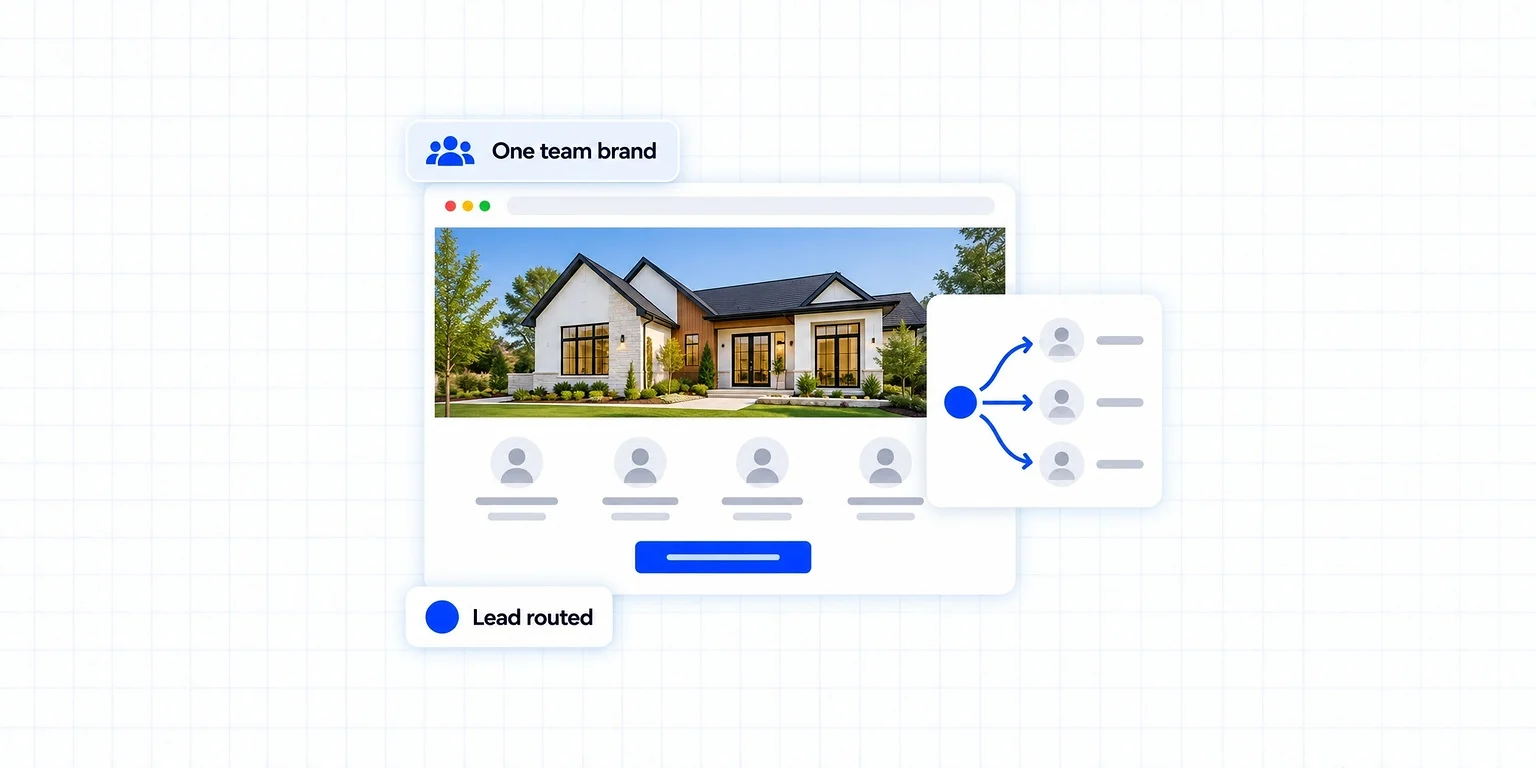
Whatever the method, three rules apply. Leads should reach the agent’s phone within minutes. If the agent does not respond within a set time, the lead should move to someone who will. And every lead should be logged in a shared CRM, so the team leader can see response times and outcomes. Most team CRMs handle this routing once the website sends leads into them, which is what CRM integration sets up.

One Team Brand, Many Agents
Every real estate team website has to resolve a tension: the team brand needs to be strong, but agents want their own presence. The website can serve both if you decide the rules up front.
- The team brand leads. One logo, one color palette, one tone of voice across every page.
- Agents shine inside it. Profile pages, their own reviews, their own blog posts under the team name.
- Agent landing pages if needed. Some teams give agents a page or subdomain they can share personally, still in the team’s design and still feeding the team CRM.
- Clear ownership of leads. Write down which leads belong to the team and which to the agent, and make the routing match it.
Also confirm your brokerage’s and state’s advertising rules for team names and brokerage disclosure, and build them into the site footer and profiles from the start.
Content Strategy for a Real Estate Team Website
A team has an advantage over a solo agent when it comes to content: more people, more local knowledge, more stories. A real estate team website can use that to rank for far more local searches than any one agent could cover alone.
- Assign areas. Each agent owns the page for the neighborhood they know best, and keeps it current with recent sales and local news.
- Share the writing. One post per agent per month adds up to a steady stream of local content without burdening anyone.
- Answer real questions. Collect the questions clients ask each agent and turn the best ones into posts and FAQ answers.
- Publish market updates under the team name, with the agent who wrote each one credited.
- Link it all together. Posts link to area pages, area pages link to the agents who cover them, and every page leads to a search or a seller request.
The keyword side of this is covered in real estate SEO keywords: one main keyword group per page, so the team’s pages never compete with each other.
Using the Website to Recruit Agents
For a growing team, the real estate team website is also a recruiting tool. Agents considering your team will look at it closely. A careers page should cover:
- What kind of agent you are looking for.
- What the team provides: leads, marketing, admin support, training, systems.
- How the team works day to day.
- Stories from current agents, in their own words.
- A simple, confidential way to start a conversation.
Keep recruiting enquiries separate from client leads, so they go to the team leader rather than into the client routing.
A Real Estate Team Website Home Page, Section by Section
The home page carries most of the weight on a real estate team website. Here is a structure that works, top to bottom.
- Headline and promise. Who you help and where, in one line: “Selling and buying homes across [area], with a team behind every move.”
- Two clear paths. One button for sellers (home value or listing consultation), one for buyers (search homes).
- Why a team. Three or four short points: coverage, specialists, availability, a tested process.
- The people. Faces and roles, each linking to a profile.
- Results. Recent sales and a handful of reviews, with the agent’s name on each.
- Areas. The neighborhoods you cover, each linking to its own page.
- Process. How a client works with the team, step by step.
- Final call to action. A short form or booking link, routed to the right person.
Sellers are the most valuable visitors. NAR’s 2025 Profile of Home Buyers and Sellers reports that 91% of sellers used a real estate professional, so every real estate team website should make the seller path at least as prominent as the home search.
Launching a Real Estate Team Website: A Simple Plan
- Agree the routing rules with the team before anything is built: who gets which leads, how fast they must respond, what happens if they do not.
- Collect agent material: photos taken in one session for consistency, short bios, areas, specialties and each agent’s best reviews.
- Write the area pages, assigning each area to the agent who knows it best, so the content is genuinely local.
- Connect the CRM and test every form and the IDX registration with real phones, checking that each lead lands with the right agent.
- Train the team on how leads arrive, what to update in the CRM, and how to share their profile pages.
- Launch, then review after 30 days: response times, lead sources and which pages bring enquiries.
How to Measure a Real Estate Team Website
The team leader should look at a handful of numbers every month. They show whether the real estate team website is working and whether the routing is fair.
- Leads by source: search registrations, seller requests, contact forms, profile pages.
- Response time by agent: one of the clearest signals you can act on.
- Leads to appointments to closings, by agent and by source.
- Top pages: which area and profile pages bring visitors and enquiries.
- Profile freshness: any agent page not updated in six months.
Share the numbers with the team. Transparent routing and results reduce the friction that lead distribution often causes.
Common Real Estate Team Website Mistakes
- A solo site with a team page added. The home page should sell the team, not one person.
- One shared inbox. Leads sit unanswered because everyone assumes someone else has it.
- Thin or outdated profiles. Agents who left months ago, or profiles with no reviews or areas.
- No routing rules. Leads go to whoever the leader remembers, which is neither fast nor fair.
- Agents building separate sites that compete with the team site for the same searches.
- Not checking how per-seat pricing scales before you grow. Check the per-user pricing before you grow. I broke down one platform’s seat pricing in Real Geeks pricing.

What a Real Estate Team Website Costs
A real estate team website costs more than a solo site because there is more to build: profiles, routing, careers and often more areas. There are two broad routes.
A team platform charges a monthly fee, often with per-user pricing for each agent. That is easy to start and grows with the team, in both capability and cost.
An owned team website is a one-time build plus IDX and hosting, connected to whichever CRM the team uses. The cost does not rise with every agent you add, and the site stays with the team. Reaplex plans start from $685 one-time for focused sites, with team and brokerage builds quoted on a call. I set out the general numbers in real estate website cost.
Frequently Asked Questions About Real Estate Team Websites
What should a real estate team website include?
A home page that sells the team, buyer and seller pages, IDX search on your domain, an agent profile for each team member, area pages, reviews and results, a careers page, and lead routing into a shared CRM.
Should each team member have their own website?
Usually not a separate one. A strong profile page or landing page within the team site gives agents a personal presence while keeping the brand, the search value and the leads in one place.
How should a team route website leads?
Round robin, by area, by lead type, by source, or first to claim, depending on the team. Whatever the method, leads should reach an agent within minutes, move on if not answered, and be logged in a shared CRM.
Do team websites need IDX?
Yes, if the team works with buyers. Buyers should be able to search on the team’s own domain, with registrations routed to the right agent.
How many agents does a team need before it needs a team website?
As soon as two or more agents share leads and a brand. Even a small team benefits from profiles, a shared CRM and clear routing, because the alternative is leads falling between people.
Can agents write blog posts on the team website?
Yes, and they should. Posts written by the agent who knows an area are more useful and more local than anything generic. Publish them under the team brand with the agent credited, and link each post to that agent’s profile and area page.
How do we handle agents who leave the team?
Remove or redirect their profile page promptly, reassign their open leads in the CRM, and make sure the leads and content created on the team site stay with the team.
What is the difference between a team website and a brokerage website?
A team website sells one team inside a brokerage. A brokerage website supports many agents and teams, with office pages, agent rosters and recruiting at a larger scale. The guide to websites for brokers and teams covers both.
How many pages does a real estate team website need at launch?
Start with the nine pages above plus one profile per agent and your top three area pages. That is enough to rank, convert and recruit. Add more area pages and blog posts every month once the core is live.
Can a small team of two or three agents use a real estate team website?
Yes. A small team needs the same structure on a smaller scale: one brand, a short team page, a profile for each agent and a single routing rule. A real estate team website that small can launch quickly and still grow with you as you hire.
What I Would Do
Write down how your team actually works: who handles which leads, how fast, and how you track them. Then build the real estate team website around that, not the other way round. A site that matches your routing and showcases every agent will outperform a prettier one that does neither.
I build team websites you own, with agent profiles, IDX on your domain and lead routing into your CRM. 200+ sites, a 5.0 rating from 180+ verified reviews, and most go live in 2 to 4 weeks. Book a free consultation and bring your team’s routing rules.
Want this done for your website?
Book a free, no-pressure call and I’ll map exactly how your real estate website can capture more leads, and what it costs to own it.

Asraful has built 200+ real estate websites with IDX and MLS integration, rated 5.0 across 180+ verified reviews. He writes about owning your website, lead generation and getting found on Google.
More about Reaplex