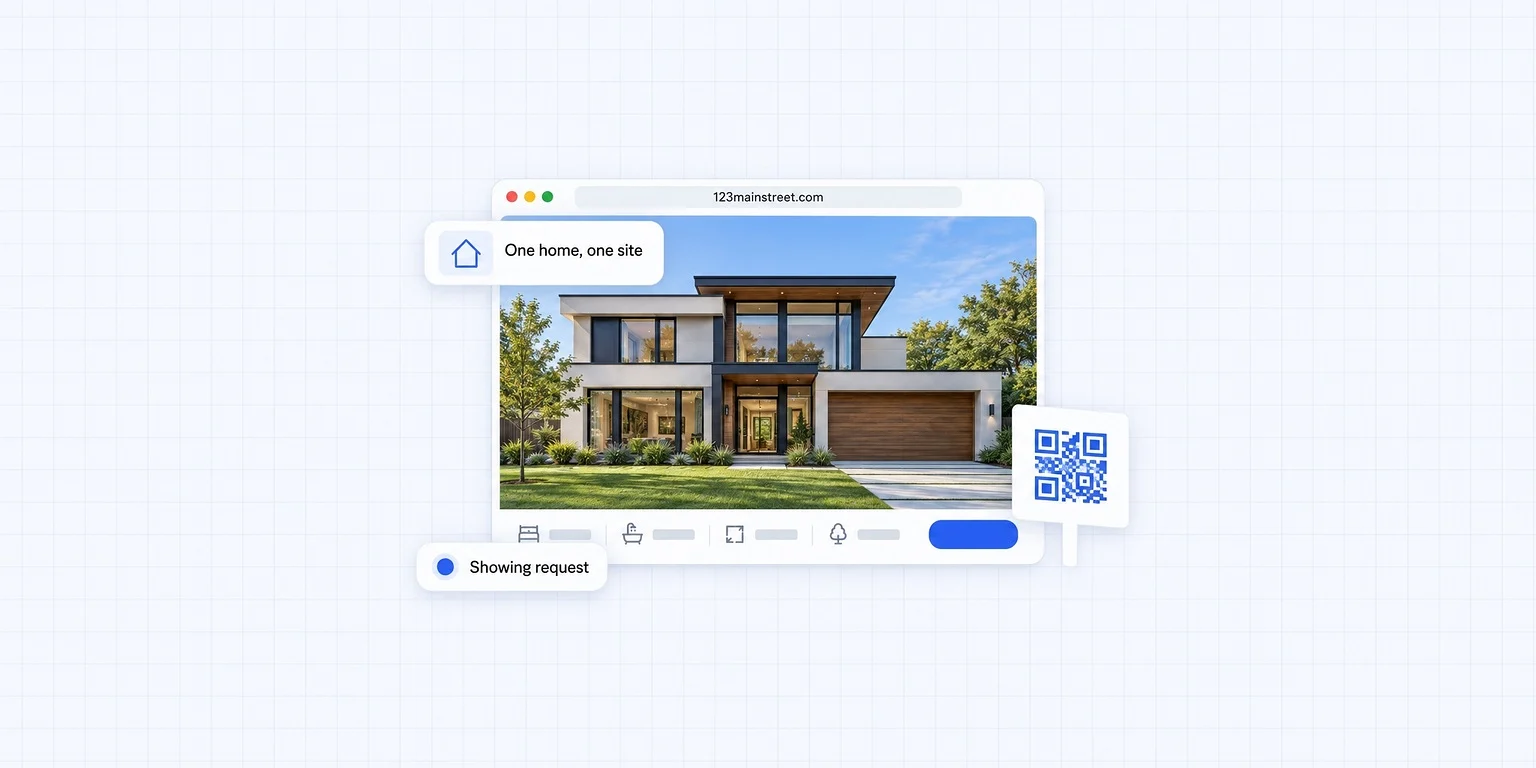
Quick answer: A single property website is a dedicated website for one listing, usually on its own address-style domain such as 123MainStreet.com. It shows the home with full-screen photos, video, a floor plan, the neighborhood and one clear way to contact the agent, with nothing else competing for attention. Agents use one to win listing appointments, to market special homes, and to collect buyer enquiries directly instead of through a portal. This guide covers what to put on a single property website, when it is worth it, how to promote it, and the mistakes that waste one.
Most listings live on the MLS and the portals, side by side with thousands of others and with other agents’ ads next to them. A single property website takes one home out of that crowd. I build these for agents, and I have seen them do two jobs: market the home, and market the agent to every seller who sees it. Both matter, and the second is often the bigger one.
What This Guide Covers
- What a single property website is
- When a single property website is worth it
- Portal, listing page or single property website?
- What to put on a single property website
- Choosing the domain
- How to promote it
- Using it in your listing presentation
- What to do after the home sells
- Who should build it
- What a single property website costs
- A launch-day checklist
- Common mistakes
- Frequently asked questions
What a Single Property Website Is
A single property website is a small, focused site built around one home. It usually has:
- Its own domain, often the street address, or a subdomain or page on the agent’s site.
- One subject. No other listings, no blog, no menu of services. Just the home.
- One action. Book a showing, ask a question or download the brochure, all going straight to the listing agent.
It is different from a portal listing in one important way: nobody else is on the page. On a portal, a buyer looking at your listing sees other homes and other agents. On a single property website they see only this home and only you.

When a Single Property Website Is Worth It
Not every listing needs one. A single property website earns its keep when at least one of these is true:
- The home has a story. Architecture, history, a view, land, a renovation. Things a portal’s template cannot tell well.
- The price point is high enough that buyers expect a premium presentation, and sellers expect their agent to provide one.
- You are competing for the listing. Offering a dedicated website in your listing presentation sets you apart from agents offering only the standard plan.
- You will run ads or print. A clean, memorable address works on yard signs, flyers, postcards and social ads in a way a long portal link never will.
- It is a new development or a unique property type, such as a small project, a waterfront estate or a historic home, where the marketing lasts longer than a typical listing.
For a standard home that will sell in a weekend, a strong listing page on your own agent website may do the same job. The point is not to build a single property website for every listing. It is to use one where it changes the outcome.
Portal Listing, Listing Page or Single Property Website?
Every listing appears in at least one of three places. They do different jobs, and the best marketing uses all three.
- The portal listing reaches the most buyers. NAR’s annual Profile of Home Buyers and Sellers consistently finds the internet is where buyers most often find the home they buy, so the listing has to be there. But the page belongs to the portal, and other agents can advertise beside it.
- A listing page on your own website sits next to your other listings and your home search. It is good for every listing, and it builds your site.
- A single property website is a stage for one home. It is the strongest presentation and the cleanest address to promote, and it is best kept for the listings that deserve it.
A sensible pattern: every listing goes on the portals and on your own site, and the special ones also get a single property website, linked from both.
What to Put on a Single Property Website
The best single property website is short, visual and finished. These are the sections I include, in this order.
1. A full-screen hero
The single best photo, edge to edge, with the address and the price. That is the first impression, and it should feel like the home.
2. The key facts
Beds, baths, square footage, lot size, year built, and the two or three features that matter most. Short, scannable, near the top.
3. The photo gallery
Professional photography, in a sensible order: arrival, living spaces, kitchen, bedrooms, outdoor space. Let buyers swipe through on a phone, because most will.
4. Video and aerials
A walkthrough video, and drone footage if the setting is part of the appeal. Video gives buyers the feeling of the home in a way photos cannot.
5. The floor plan
A clear floor plan answers questions that photos raise. Serious buyers look for it.
6. The story
Two or three short paragraphs about the home and the life it offers. Written in plain, specific language, not a list of adjectives.
7. Location and lifestyle
A map, nearby schools, dining, parks and commute times. Buyers are choosing a place as much as a house.
8. One clear enquiry
A short form to book a showing or ask a question, plus your phone number. The enquiry should reach you within minutes, ideally on your phone or in your CRM.
9. You
Your photo, name, brokerage and contact details, as your MLS and state rules require, and a link to your main website. This is the part that keeps working after the home sells.

Choosing the Domain for a Single Property Website
The domain is part of the marketing. Three options, each with its trade-off:
- An address domain, such as 123MainStreet.com. Memorable, perfect for signs and print. It needs to be registered and renewed, and pointed somewhere sensible once the home sells.
- A subdomain of your site, such as 123main.yourname.com. Clearly connected to your brand, and nothing new to register.
- A page on your own site, such as yourname.com/123-main-street. The simplest, and any search value it earns stays with your main site.
Whichever you choose, register it in your own name or your brokerage’s, not a vendor’s. If you use an address domain, keep it in the same account as your main domain, so nothing gets lost.
How to Promote a Single Property Website
A single property website only works if people see it. These are the places to put the address:
- The yard sign, with the domain or a QR code.
- Flyers and brochures at showings and open houses.
- Social posts and ads, sending traffic to the site rather than to a portal.
- Your email list and sphere, with a short “just listed” note.
- The MLS virtual tour field, where your MLS rules allow a branded or unbranded tour link. Check the rules for your board.
- Your own website and Google Business Profile, linking to the listing.
The point of sending traffic to your own single property website rather than a portal is simple: every enquiry comes to you.
Using a Single Property Website in Your Listing Presentation
This is where a single property website often pays for itself. Sellers interview several agents. Most offer the same plan: MLS, portals, photos, an open house. Showing a seller a live example of a single property website you have built for a previous listing, and telling them their home will get one too, changes the conversation.
Bring a real example, open it on your phone (the same way you would show sellers your own agent website), and hand the phone to the seller. Let them swipe through the photos and watch the video. Then explain where the address will appear: on the sign, the flyers, the ads, the emails. Sellers are buying how their home will be presented. A single property website shows them, instead of telling them.
Every seller who sees it also sees the kind of agent you are, which is why I call it marketing for the agent as much as for the home.
What to Do After the Home Sells
Do not let the single property website disappear into a dead page. Turn it into a “just sold” page: change the headline, keep the photos, and add a line about the result and a link to your home value page. Then it keeps working as proof for the next seller.
If you used an address domain, decide whether to keep renewing it or to redirect it to your main site. A redirect keeps any links and searches pointing somewhere useful.

Who Should Build It: You, a Tool, or a Designer?
There are three common routes, and the right one depends on how many listings you take.
A do-it-yourself template suits an agent with a few listings a year who is comfortable with a website builder. It costs little, but the result depends on your time and eye, and it usually lives on a separate platform from your main site.
A dedicated listing-site tool gives you a ready-made format you fill in for each home. Fast and consistent. Check whether the pages sit on your domain or the tool’s, and what happens to them when you stop paying.
A reusable template built into your own website is what I usually recommend for agents who list regularly. A designer builds the layout once, matched to your brand, and you or your assistant fill it in for every new listing. Each page lives on your own domain, every enquiry goes into the same system as the rest of your leads, and the sold pages keep building your site’s authority.
Whichever you choose, the deciding questions are the same: does it look right on a phone, do enquiries reach you fast, and do you own the pages afterwards?
What a Single Property Website Costs
The cost of a single property website depends far more on how it is built than on the site itself. Think about it in three parts.
- The domain. A .com address domain typically costs $10 to $25 a year at a mainstream registrar. If you use a page or subdomain on your own site, there is nothing extra to buy.
- The media. Professional photography, video and a floor plan. You may already be paying for these as part of your listing marketing; a single property website simply shows them off properly.
- The build. A focused one-page site, either built from a template you reuse for each listing, or custom. A reusable template on your own website is often the most cost-effective option: you pay once and fill it in for each new listing.
Seen that way, a single property website is less a new expense than a better way to use the photography and video you already pay for. For the wider picture of website costs, see real estate website cost.
A Launch-Day Checklist
Before you put the address on a sign, run through this list on your phone:
- The hero photo loads fast and looks right on a small screen.
- The price, address, beds, baths and square footage are correct and match the MLS.
- The gallery is in a sensible order and every photo is sharp.
- The video plays on a phone without sound by default.
- The floor plan opens and is readable when you zoom.
- The enquiry form works, and a test enquiry reaches your phone or CRM within minutes.
- Your name, brokerage and license details appear as your MLS and state rules require.
- The page has a sensible title and description, so it looks right when shared by text or social.
- The QR code on the flyer and sign opens the right page.
Fifteen minutes with this list prevents most of the problems that make a single property website look unfinished.
Common Single Property Website Mistakes
- Launching after the listing goes live. The best traffic comes in the first days. Have the site ready for launch day.
- Weak photography. A single property website puts photos front and center. Poor photos are more visible, not less.
- Too many calls to action. One clear enquiry beats five competing buttons.
- Slow on a phone. Large video and images need to be optimized, or the site will be slow exactly where buyers look.
- Leads to the wrong inbox. Enquiries should reach the listing agent fast, not a shared office address.
- Deleting it after the sale. Turn it into a sold page instead.
Frequently Asked Questions About Single Property Websites
What is a single property website?
It is a dedicated website for one listing, usually on its own domain, with photos, video, a floor plan, the neighborhood and one way to contact the agent. Nothing else competes for attention.
Do single property websites help sell homes?
They give special homes a presentation that portals cannot, and they send enquiries straight to the listing agent. They also help win listings, because sellers can see how their home will be marketed.
Should every listing have a single property website?
No. Use one for homes with a story, higher price points, listings you are competing for, and homes you will promote with print and ads. A good listing page on your own site can do the job for the rest.
What domain should I use?
An address domain is memorable and great for signs. A page or subdomain on your own site is simpler and keeps search value with your main site. Register any domain in your own name.
How fast can a single property website be built?
Because the scope is focused, it can be built quickly, in time for the listing to go live, as long as the photos, video and details are ready.
What happens to the website after the sale?
Turn it into a “just sold” page with the result and a link to your home value page, or redirect the domain to your main site.
What I Would Do
Pick your next listing that has a story, build it a single property website for launch day, put the address on the sign, and keep a live example on your phone for every listing presentation after that. One good example is worth more than any slide in your pitch.
If you want one built, I make single property websites that are ready for launch day, owned by you, with enquiries sent straight to your phone. 200+ sites, a 5.0 rating from 180+ verified reviews. Book a free consultation and bring your next listing.
Want this done for your website?
Book a free, no-pressure call and I’ll map exactly how your real estate website can capture more leads, and what it costs to own it.

Asraful has built 200+ real estate websites with IDX and MLS integration, rated 5.0 across 180+ verified reviews. He writes about owning your website, lead generation and getting found on Google.
More about Reaplex